
By Beatriz Palmer
It’s 4:00 a.m.
The alarm rings before the sun even contemplates rising. Loncheras are packed with burritos wrapped in foil, and thermos are filled with cafecito, enough to share and last the long day. Uniforms consist of dark clothing to hide the dirt, cachuchas and panuelos—some will tie the pañuelo across their face to guard against sun and dust while others wrap it around their forehead to catch the sweat running down their foreheads. Long sleeves button at the wrist, even in heat, for protection. In many homes, parents leave before their children wake, before daylight. Hands split open over time, and calluses are layered like lines on a history book. Workers harvest the food that feeds the nation while absorbing the cost in their own bodies.
Before the marches and the union contracts, there were mornings like this. And there still are.
Agriculture in North County San Diego doesn’t look the way it once did. The rows that stretched long across our valleys have shifted. Some fields gave way to development for fancy stores and homes our farmers can’t afford. Others transformed into nurseries, flower growers, greenhouses, and warehouses tucked behind industrial buildings. The labor did not disappear—it just became less visible—but still underpaid.
You may not see acres of tomatoes, strawberries, cucumbers, and cauliflower once grown here in our own communities. But you still see workers struggling to make ends meet across Oceanside, Carlsbad, Fallbrook, and Vista. It was from realities like these that the farmworker movement emerged.
Most of us learned the name César Chávez first—and rightly so. His commitment to nonviolence and his prolonged hunger strikes, some lasting more than three weeks, brought national attention to unsafe working conditions, low wages and pesticide exposure. Those fasts placed moral pressure on growers and lawmakers. César’s sacrifices eventually led to change but also took a toll on his body. He cofounded what became the United Farm Workers, securing contracts and elevating agricultural labor into the national conversation on worker rights. But the movement was never built by one person.
In 1965, the Delano Grape Strike was initiated by the Filipino labor leader Larry Itliong, a seasoned organizer who understood that growers relied on division—Mexican against Filipino, immigrant against citizen. Instead, Filipino and Mexican workers chose solidarity. Itliong invited Chávez and the National Farm Workers Association (NFWA) to join, creating a movement rooted in unity, not division. Too often his name is omitted when the story is told. But without Filipino leadership, there is no Delano strike.
And alongside them were women—maestras, mamás, tías, and amas de casa—who traded aprons and household chores to organize meetings and knock on doors.
Women like Dolores Huerta were often criticized for leaving their children in the care of family so they could organize, as if mothers cannot hold both love for their children and responsibility to the community.
Sra. Huerta, a former teacher, left the classroom to empower adults—especially mothers—believing that when families understand their rights, movements grow stronger. She cofounded the NFWA in 1962, negotiated contracts, and lobbied lawmakers; from her organizing came the powerful chant “Sí se puede”—a declaration of determination and strength born out of struggle.
Even before Dolores Huerta, there was Maria Moreno—an undocumented farmworker and mother of 12 who organized in California in the 1950s. She spoke publicly about labor rights and her immigration status at a time when doing so carried enormous risk—a reality that still resonates today. Her name rarely appears in textbooks, yet she laid groundwork for the movement that followed.
Helen Fabela Chávez, a farmworker and mother of eight, sustained the union through years of sacrifice. Jessie de la Cruz recruited women directly from the fields, reminding them that leadership did not require permission.
The farmworker movement was not only about wages. It was about family stability and human dignity, and it was about women empowerment.
When I think about women in North San Diego County, I think not only of those who made history. I think of my mother, Graciela Mora, my tía Trinidad Contreras, and the many ladies with whom my mother built community in the fields. Her callused hands and years of a strained back can tell the stories. She, like many, bore a quiet strength that did not ask for recognition.
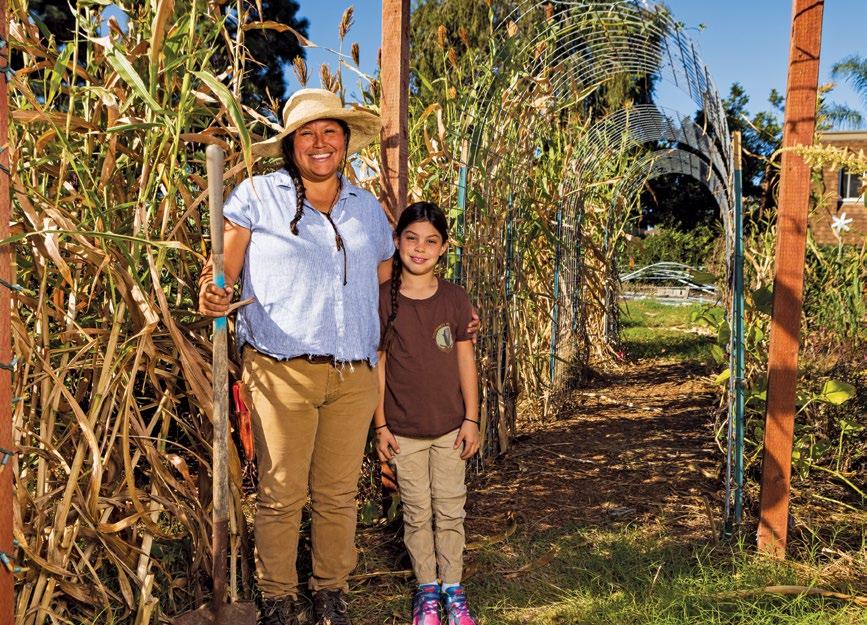
I think of women like Bianca Bonilla, a community hermana I met while working at MiraCosta College, an educated botanist, businesswoman, and a dedicated single mother raising her daughter, Mayita, a young yet fierce little warrior. Bianca has nurtured in her a love for nature, seeds, soil, creative arts, and the sacred elements that birth our food. Through Plants, People, Community—formerly Botanical Community Development Initiatives—Bianca creates spaces rooted in food sovereignty, creativity and art, cultural belonging, and inclusive care. She guides youth into trails, teaching which plants nourish, which heal, and which simply coexist as part of a sacred ecosystem. She tells the story of each plant and seed with purpose. She teaches a love for the maize, the elements, the milpas, and the ancestors who left us these legacies. She’s a different generation but birthed from the same roots.
This March, in honor of César Chávez, Dolores Huerta, Maria Moreno, Larry Itliong, and all the warrior women whose names history sometimes omits or ignores, plant something. Support your local farmer. Visit your farmer’s market. Light a candle, remember the planters and the workers, and support the organizations continuing this work today.
At Cal State San Marcos, the statue of César Chávez stands not as a relic, but as reminder. Each year the university gathers students, faculty, nonprofit partners, and community leaders to honor his legacy—and the activists, Filipino leaders, and women who carried the movement forward. The campus pauses classes not for a day off but for a day of service. This year participants will hear from Dra. Arcela Núñez, the cofounder of Universidad Popular.
Participants then go into places that have historically served and created space for farmworkers and their families, places like Universidad Popular, TrueCare, CSUSM La Milpa Project, Boys and Girls Club Vista, Produce Good, and Botanical Community Development Initiatives AKA Plants, People Community. Honoring this history requires more than remembrance; it requires action.