
By Beatriz Palmer
The alarm rings, and it feels as though she just laid her head on the pillow. She gets up, jumps in the shower, makes her cafecito, prepares the lonche and a quick breakfast for her and the familia; sometimes it’s cereal and sometimes burritos. Then she finally takes a quiet moment for herself before the second alarm rings to wake the kids for school.
She moves through the morning with intention, getting them ready, out the door, and ready for school with all their backpacks and homework. She feels grateful to be able to take her children to school, to be present in those small ways, which are often big privileges. She kisses them goodbye, reminds them to listen to the maestros, make good choices, and have lots of fun along the way. Then, without pause, she heads to work—and for a group of moms, their next stop is their own class; this time she’s the student. Some moms run from classes to work. Their common thread—the day continues, full and demanding, until it’s time to pick them up from school again. Evenings fill quickly with tareas, permission slips, surprise projects, and extracurricular activities like Little League, cheer, ballet folklorico, and all the spaces where her children get to shine, all while still cooking and listening to the kids talk about the playground drama. She’s really good at making it all seem effortless; she supports, she holds it all together, and leaves us wondering, “How does she do it?” Some may not have their own kids anymore but hold down multiple jobs, all while helping their own hijas and hijos pick up the grandbabies or watch them in the evenings or on weekends.
As the bedtime routines settle in, and the house begins to quiet down, her third shift is just beginning. She pulls out her books, working on a discussion post, a research paper, studying for biology, or working through math problems that leave her wanting to quit. Then she remembers her mother or abuela’s voice “échale ganas, mijita!” and leans into preparing for a group activity while secretly hoping that her contributions, filled with wisdom and lived experience, will be seen, valued, and heard. This is not just her routine. It is a reality for many non-traditional college students who are also moms and caregivers.
Some days, she feels like she belongs. Other days, she finds herself in that in-between space—what the late Chicana writer and scholar Gloria Anzaldúa calls Nepantla, a third space or a space of transition, of becoming, and of questioning. “Is college really for me, or should I give up my own dream?”
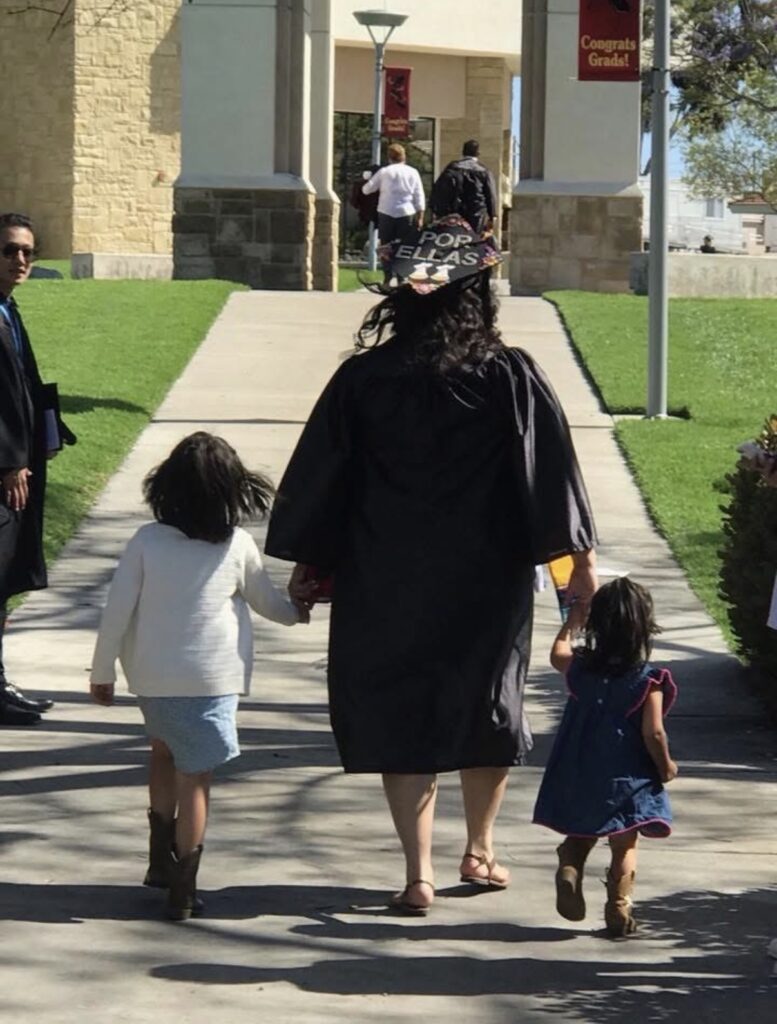
For generations, Chicana and Latina women have been taught the value of sacrificio, often rooted in Marianismo, a cultural expectation anchored in faith that honors selflessness, caregiving, and putting others first. It is beautiful in its intention, but heavy in its expectation, often asking women to set aside their own suenos y esperanzas. Somewhere along the way, we learned a different kind of wisdom—one that doesn’t wait for the perfect time, one that reminds us: “A darle, que es mole de olla,” a Mexican dicho often said to remind us to keep moving forward. So, we redefine what it means to carry dreams alongside responsibility.
These mothers are not just going back to school—they are coming back for it all. They are the dreams of their ancestors, walking into classrooms that were never built with them in mind. The new Latinas and Chicanas are showing up in higher education in powerful ways. Over the past two decades, the number of Latinas earning college degrees has more than doubled, growing from about 1 million to over 3.5 million. Today, Latinas represent a strong and growing presence in higher education, earning degrees at higher rates than Latino men. Many are the first in their families to step onto a college campus and become las graduadas.
And yet, inequities remain. Only about 23% of Latina adults hold a bachelor’s degree, compared to over 40% of non-Hispanic women—not because of a lack of ability, but because of the responsibilities they carry and the systems that invisibilize them.
Many of these students are what colleges/universities call “non-traditional”—older students who are working, raising children, caregiving, healing, all while pursuing their education. They are strong mujeres guerreras (women warriors) in our communities, carrying generations of knowledge across their families, into their communities, and into the classroom.
Research shows that adult learners and student parents bring persistence, discipline, and real-world problem—solving skills that deepen learning environments. They connect theory to lived experience often left out of the textbooks. They are not just navigating education; they are transforming it.
And behind every data point, there is a real story.
Maria Mireles
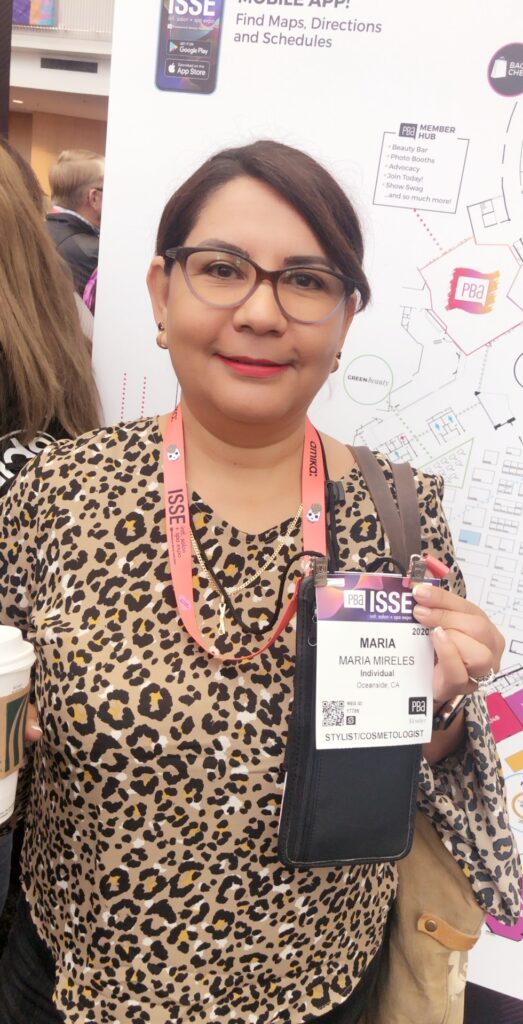
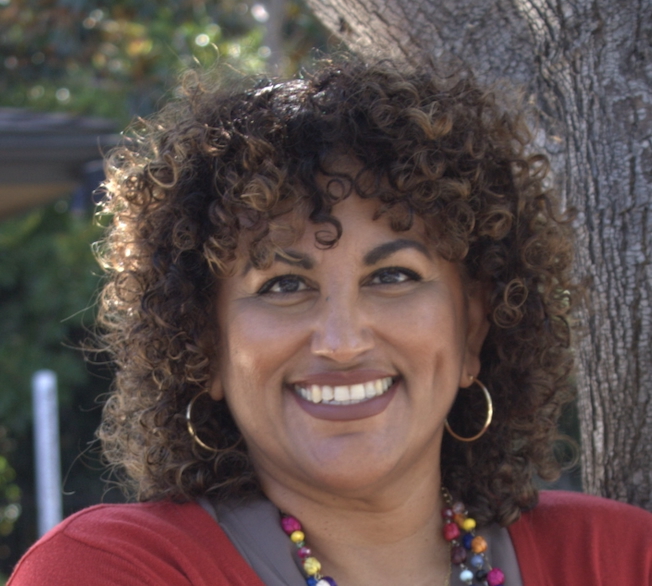
Maria Mireles is one of them. A retired educator who worked for Vista Unified School District for 29 years, a wife, mother, grandmother, and community leader, Maria returned to school with a simple goal—to complete her associate’s degree for herself. Coincidentally, while she worked on her AA, her daughter was pursuing her education at the University of California, Berkeley, a powerful example of intergenerational learning and strength.
“Going back to college was something I always wanted to do but I didn’t feel I could do it… I decided to reach out to a counselor and chose to try, and I did.”
Maria supports her family by caring for her granddaughter, taking her to school, and picking her up, ensuring she is surrounded by love and stability. After a lifetime of giving support, she now allows herself to receive it, showing up for tutoring, attending office hours, and using every available resource because, as she shares, the struggle is real—and asking for help is part of the journey. The consejos she once gave her students are the same ones she now lives by. She is both the loving wife, mother abuela and the student. Today, Maria came back to school again, this time she is pursuing a bachelor’s degree at Cal State San Marcos—¡adelante, Maria!
“It was difficult because it was all online… but I kept going. Now I’m enrolled at CSUSM as a transfer student. What keeps me going is the need to learn new things, gain knowledge–it keeps me alive and feeling young.”
Vanessa Hernández
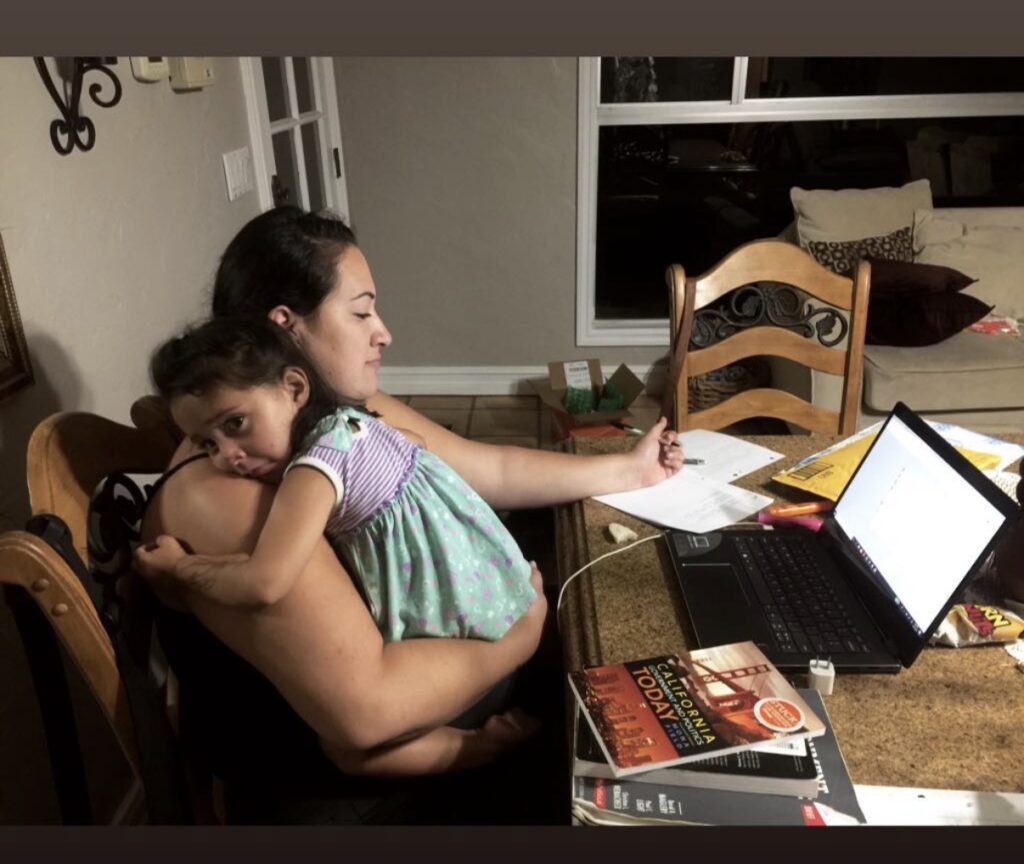
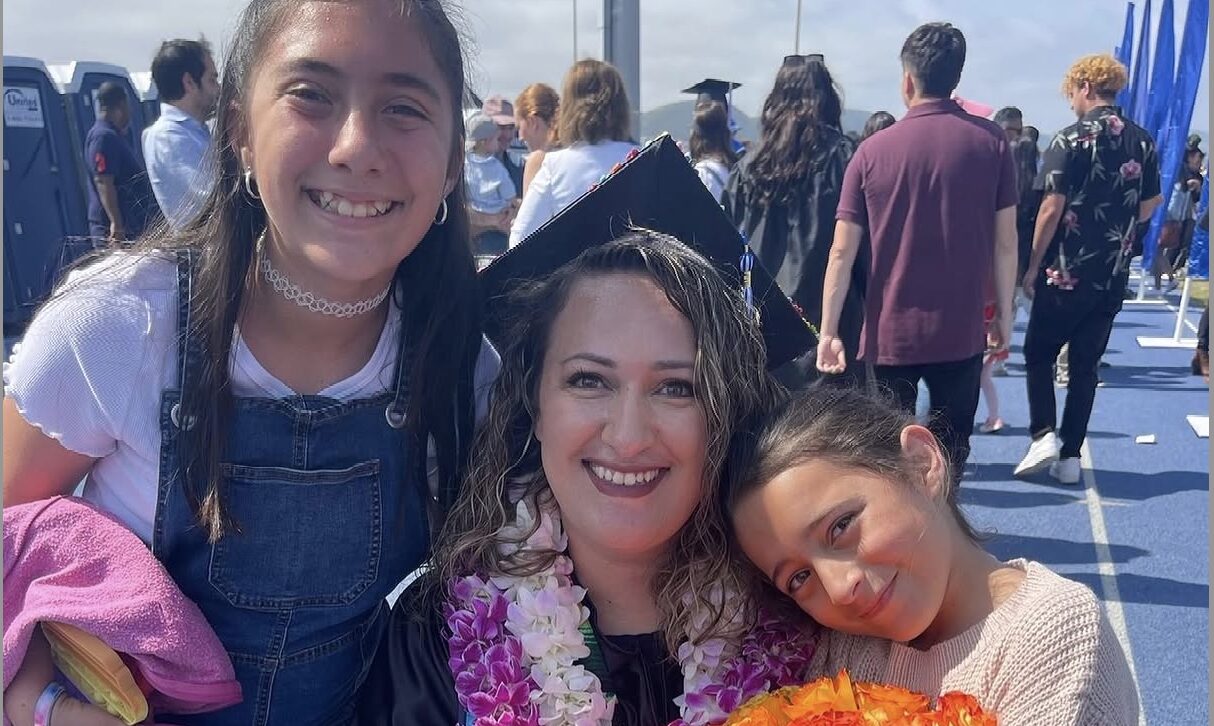
Vanessa Hernández is another. At the time, she was divorced and a single mother of two beautiful and brilliant niñas. Vanessa returned to college while working and raising her daughters, volunteering for field trips, supporting tareas, and making time for after-school activities like sports, theater, and ballet folklórico—the spaces where her daughters get to glow in their talent. She comes from a lineage of passionate educators and maestras de ballet folklórico. Her mother, Olga Moreno, was, coincidentally, my own maestra of third grade and ballet folklórico—she modeled a love for teaching rooted in culture, discipline, and care—a legacy Vanessa continues to carry forward.
“Going back to school was a hard choice. I was a stay-at-home mom with no degree wondering how I’d support my girls… so I decided to sacrifice a few years to put myself in a position where I’d never again have to depend on anyone.”
Her daughters witnessed everything—the sacrifices, the late nights, and sometimes the tears, the laughter, and the persistence of not giving up and using the ganas deeply rooted in her own mother’s legacy.
“There were times I felt embarrassed about being ‘behind,’ but now my kids have had a front-row seat to what it looks like to achieve those dreams not once, but three times.”
They saw her earn her AA, her BA, and her teaching credential with bilingual authorization—and soon they will watch her cross the stage a fourth time as she begins her master’s program. Today, Vanessa is a dual-immersion elementary school teacher, living the very dream her daughters and loved ones saw her fight for.
“We are transforming our legacy… from knowing our place to becoming guerreras of hopes and dreams.”
Sandra Mora
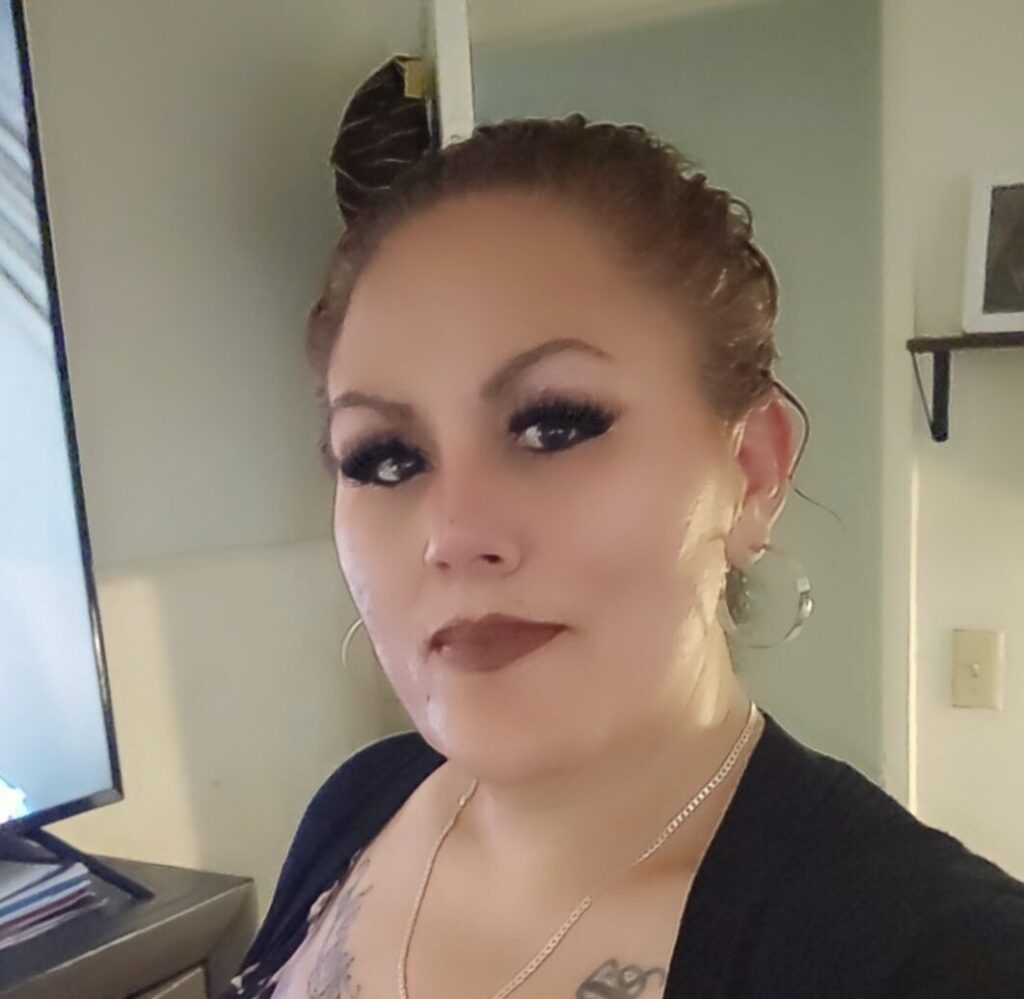
Sandra Mora is someone I deeply admire—mi carnala. Statistics say she shouldn’t have this level of success and impact on others’ lives, but she beat the odds in so many ways. Her journey reminds us that returning to school is sometimes an act of healing. After years of being system-impacted, a survivor of domestic violence, and navigating substance use, Sandra made the courageous decision to choose herself first, and through her faith and recovery, she found stability, health, self-love, purpose, and the respect and admiration of her loved ones.
“I started my journey with a lot of self-doubt… thinking I wasn’t good enough and asking myself why even try.”
Sandra is a daughter, sister, mother, grandmother, and life partner; she now shows up with presence and care, supporting her children and siblings from a place of strength. She returned to college on her own terms—not rushed, not pressured, but with intention—working toward an education that will lead to a degree, all while giving her clarity about her career goals.
At the beginning of her academic journey, she found something many students need but don’t always have—someone who saw her. She met Profesora Karla Cordero, an English professor who welcomed her into MiraCosta College with corazón. In that space, Sandra felt understood, like she had found someone who knew where she was coming from. That sense of belonging helped her stay.
“Seeing how my sisters overcame their struggles gave me the courage… now here I am, poco a poco, doing what I need to do for my family and me.”
Today, she works to support families experiencing homelessness and youth impacted by the system, empowering them to make healthy, informed decisions. She is becoming the counselor and educator so many families and youth desperately need, one who sets aside judgment and offers them acceptance and unconditional care. In the classroom, she brings the truth, resilience, and all her lived experiences, an invaluable contribution to the classroom learning environment.
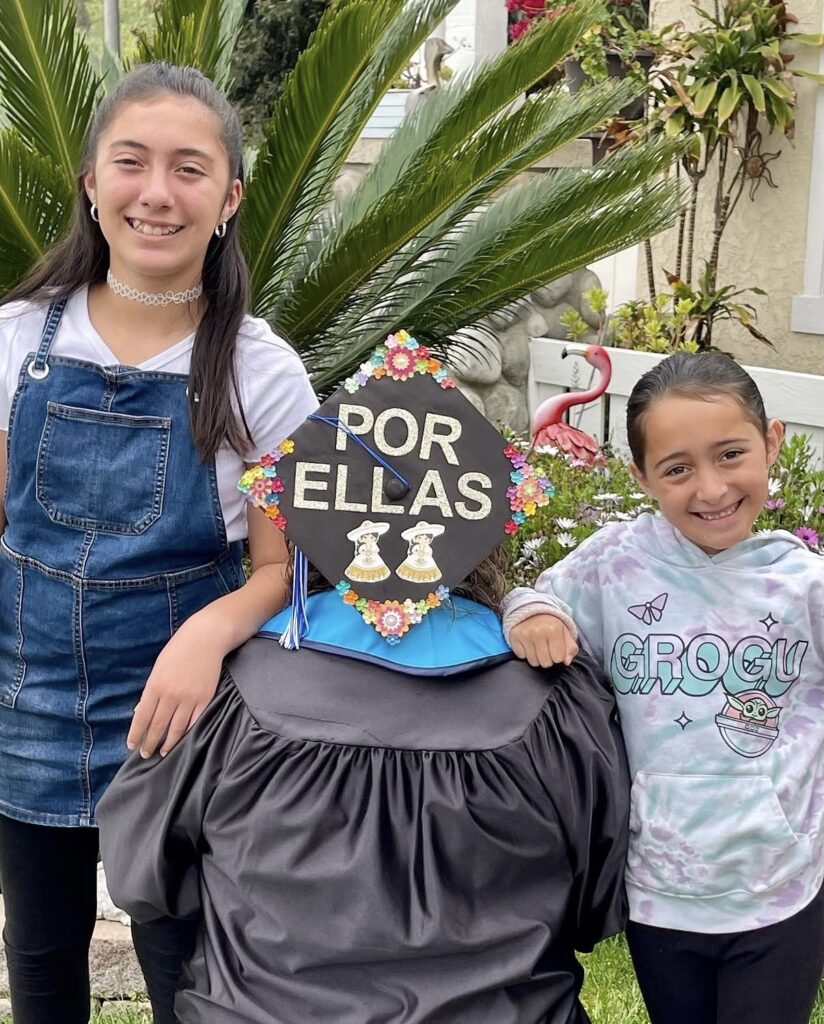
She told herself, “It is time to let go and let God lead my way.”
When we step back, we see the full picture—Maria, Vanesa, and Sandra, all different journeys, different timelines, but one shared truth: they returned to school. Some of us came back while raising children, some while supporting grandchildren, some while healing—but all of us came back carrying something deeper than books—carrying the fuerza of our great-great-grandmothers. Because we are not just women going back to school—we are the dreams of our ancestors, walking, studying, persisting, healing, and rising.
If you’re a woman in your adult season of life, wondering if you can go back to school, take in what my patrona, la Dra. Carol Wilkinson, once said, “Si vas a ser cincuentona, mejor ser cincuentona y con título.” (If you have to be 50, it’s better to be 50 with a college degree.) She’s a very wise woman, and one of my first mentors and now a lifelong friend. We do this for ourselves first, and also for those watching—our children, our grandchildren, and the women who are still wondering if they can.
Porque sí, mijita—you are strong, you are brilliant, and your wisdom and lived experience is valuable in your home, in your community, and in the college classroom.